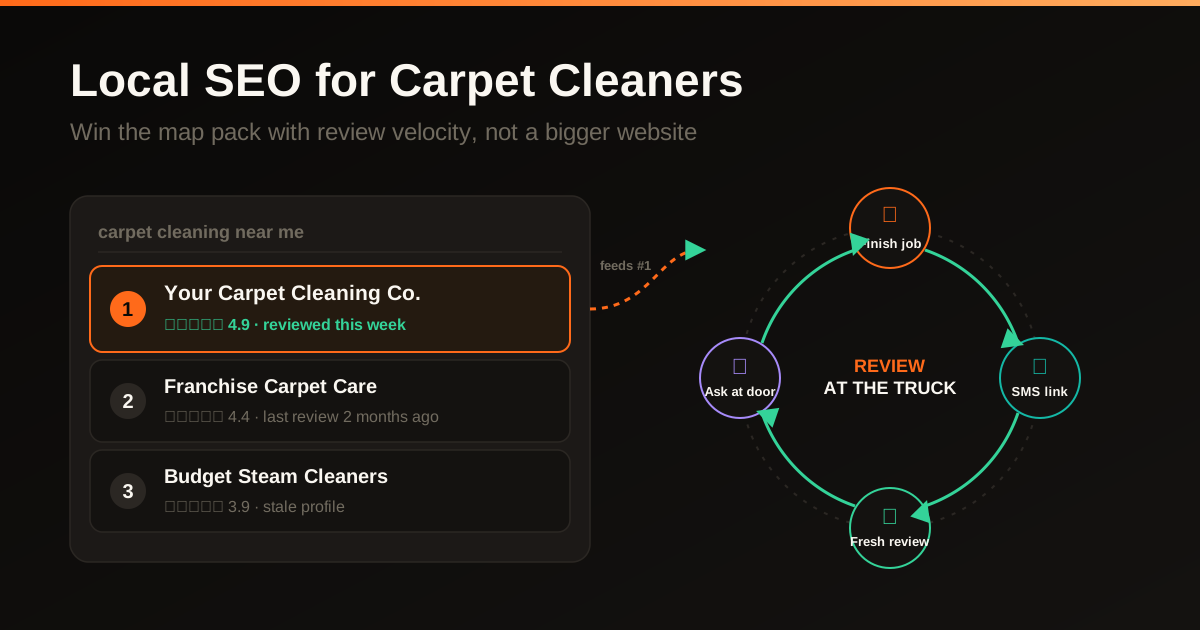
Prospective customers may use reviews to understand communication, workmanship and how a contractor handles concerns. Review count and rating are useful context, but they do not prove service quality or determine a search position by themselves.
- Uses one eligibility rule for completed customers
- Makes honest participation optional
- Routes concerns to a responsible team member
- Tracks invitations and published feedback separately
- Requests depend on staff memory
- Different customers receive different treatment
- Old links or duplicate messages go unnoticed
- Feedback is counted without a reliable invitation log
Reviews help customers evaluate past experiences, and Google identifies reviews as one part of local prominence. More reviews do not automatically produce higher placement, more calls or more revenue. Keep feedback genuine and assess outcomes separately.
How reviews and the website support different decisions
Google includes reviews in its explanation of local prominence, alongside other factors. It does not state that a strong review profile always outweighs distance, relevance, website quality or other signals.
Customers may read both recent and older reviews, including how the business responds. Do not treat older feedback as worthless or apply an unattributed survey percentage to every market.
Use a simple, neutral request and a direct review link. Track eligible requests and actual responses without a promised rating, completion time or universal conversion rate.
Some customers contact a business from its profile while others visit the website, compare referrals or return later. Reviews summarize customer experiences; the website explains services, process, evidence and contact options. Measure each path rather than assigning every inquiry to one surface.
Set a process baseline before choosing a target
Record eligible completed jobs, invitations sent, delivery failures, opt-outs and observed published reviews for a consistent period. Also record the public profile count and rating as dated observations. These measures answer different questions and should not be collapsed into one total.
Competitor counts can provide context, but matching a competitor does not guarantee the same visibility or conversion rate. Capacity also limits participation: a business completing ten eligible jobs cannot responsibly plan for twenty new reviews from that group.
Set an initial process target for eligible requests, then observe participation. For example, record four observed reviews from twenty invitations as four of twenty for that sample. This is illustrative arithmetic, not an expected rate; customers choose whether and what to review.
Turn the policy and measurement principles into a staged operating routine.
Use the 90-day review working planStep one: define who receives a request
Choose a consistent milestone such as completion, handover or a completed service visit. Apply the rule regardless of expected sentiment and document operational exceptions such as cancellations, disputed identity or missing contact permission.
A useful request identifies the completed service, invites honest feedback and provides a convenient link. It should not ask for a positive rating or pressure the customer to respond immediately.
For a deck builder, that moment is the final walkthrough, when the homeowner steps onto their new deck for the first time and sees the finished product. For a roofer, it is right after the debris is cleared and the yard looks cleaner than before you arrived. For a pool builder, it is the first fill. For a painter, it is when the tape comes off. Every trade has its version. Identify yours and build your ask around it.
The request can come from a crew lead, owner or approved workflow. Identify the business and completed service, make participation optional and ask for an honest account. Do not say you know the customer is happy or ask for a positive rating.
Step two: use the customer's permitted channel
Choose a contact channel the customer has agreed to use and keep reminders reasonable. Measure delivery and response from your own workflow rather than applying a universal SMS or email benchmark.
Text and email can both be appropriate depending on permission and customer preference. Keep the request brief, neutral and easy to act on. Do not assume one channel guarantees reviews or that the other wastes most requests.
Keep the request short and include the direct review link from the verified profile. Test the link on common devices and confirm that it opens the correct business. The customer may need to sign in, and no particular rating or completion time should be suggested.
How to generate your direct Google review link
- Go to your Google Business Profile dashboard.
- Click 'Ask for reviews' (or 'Get more reviews' depending on your interface).
- Copy the link Google generates. It will look something like: g.page/yourbusiness/review
- Keep the Google link or use a business-controlled redirect only when ownership and destination are clear.
- Save that link as a template in your phone, your CRM, or wherever you manage customer communication.
The link removes unnecessary navigation, but the operating process still needs eligibility, consent, opt-out, duplicate prevention, response ownership and reporting.
Step three: use one optional reminder
If the customer has not opted out and a reminder is appropriate, send one short follow-up after a reasonable interval. Do not claim the customer failed to review unless the system can determine that reliably.
Example: 'Hi Mike, one optional follow-up from [business]. If you would like to share feedback about the completed deck project, here is the review link: [link]. If you already reviewed us, thank you and please ignore this message.' Stop after the approved reminder or any opt-out.
Before automating, test the completion trigger, customer identity, contact permission, opt-out handling and duplicate prevention with internal test records. Do not assume a tool can always match a published Google review to the correct customer.
Step four: maintain a response and escalation process
Respond professionally to acknowledge feedback and address concerns without exposing private details. Replies can help prospective customers understand how the business communicates, but a response is not a confirmed direct ranking factor.
Keep replies relevant to the customer’s experience. Do not turn them into keyword-stuffed marketing copy or claim a guaranteed conversion or ranking lift from responding.
For positive feedback, thank the customer in a natural voice and refer only to non-sensitive details they shared. Use a response schedule the team can sustain instead of claiming a fixed deadline changes rankings.
For a concern, acknowledge it and offer a private resolution route without publishing customer, property, payment or dispute details. Verify the facts before making a public claim and report a review only when there is a genuine policy reason.
Review practices to avoid
Google may remove policy-violating reviews or restrict content and accounts. Follow its contribution rules without predicting a fixed penalty or reinstatement timeline.
- Buying reviews from freelancers, agencies, or review farms. Google's detection has gotten aggressive. Fake reviews get removed in batches and the listing often gets flagged.
- Offering discounts, gift cards, or any incentive in exchange for reviews. Google's policy explicitly prohibits incentivized reviews. It does not matter if you say 'leave an honest review.' The incentive itself violates the terms.
- Review gating: screening customers before sending them to Google so only happy ones leave public reviews. Google banned this practice specifically. You cannot filter who gets to leave a review.
- Asking employees, family members, or friends to leave reviews. These are not customers and Google can detect patterns like reviews from the same IP, location, or device.
- Posting reviews on behalf of customers, even with their permission. The review must come from the customer's own Google account.
Google prohibits fake engagement, incentives and selectively soliciting positive reviews. Follow that policy and keep records of a consistent process. Legitimate reviews can still be moderated, so do not promise that honest businesses never experience removals or restrictions.
Measure the process without inventing a ranking formula
Observe review count, rating and recent feedback as dated public profile measures. Google does not publish an exact weighting for review volume or recency, so do not forecast position from a monthly review pace.
A consistent request process creates opportunities for feedback; it does not guarantee a particular review count or increase in calls. Measure requests, responses and qualified inquiries as separate outcomes.
Use the completed-job process to invite honest feedback and learn from it. Avoid depicting reviews, rankings and revenue as an automatic causal loop.
See how accurate profiles, honest feedback, useful pages and inquiry measurement work together.
See how local SEO and reviews work togetherWhat to review after six months
After six months, review eligible jobs, invitations, delivery failures, opt-outs, observed published feedback and response handling. Compare the process with customer-service themes and qualified inquiries, but do not attribute every new review or lead to the latest request workflow without evidence.
A reliable workflow is the deliverable. Customer participation, rating, moderation, local visibility and later sales outcomes remain separate measures.
Quick wins you can do this week
- Generate your direct Google review link from your Google Business Profile dashboard and save it as a text shortcut on your phone.
- Document an inclusive eligibility rule and confirm contact permission before requesting feedback from recent customers.
- Respond to every existing review you have not responded to yet. Start with the most recent and work backward. Personalize each response.
- Pilot the workflow with internal test records before enabling a completion trigger and one optional reminder.
- Print a small 'Leave us a review' card with a QR code linking directly to the review form. Hand it to the customer at the end of every job, in addition to the text.
Reviews are the accelerant, but the engine needs more. Read how deck builders combine reviews, city pages, Google Business Profile, and citations into a full local SEO system.
See how reviews fit into the full local SEO pictureThe bottom line
Genuine feedback is useful evidence for customers and a source of operational learning. A higher review count does not prove one contractor is better or that every marketing dollar becomes more productive.
Invite honest feedback after eligible work, provide an appropriate link, use a reasonable reminder if needed and respond professionally. Customers decide whether to participate; reviews, rankings and calls are not guaranteed.
Lead & Local Growth and Local Authority include GBP management and a review request and response workflow alongside paid acquisition. Start with a free strategy call and initial audit to understand the priorities for your business.
Review the current profile, request process, policy risks and measurement plan in a 30-minute strategy call.
Book a free discovery callSources and further reading
- Google Search: SEO Starter Guide
Crawlable links, descriptive page information and content organization. Practical trade examples are SF Web Tech recommendations.
Source checked .
- Google Business Profile: local ranking guidance
Google’s broad relevance, distance and prominence guidance. No exact ranking weights or guaranteed service-area coverage are stated.
Source checked .
- Google Maps: prohibited and restricted content
Rules against fake engagement, incentives and selectively soliciting positive reviews.
Source checked .