A plumbing visitor may need urgent help or a planned estimate. Show actual service hours, covered areas and a working call path so the office can assess the request. A call is not automatically a booking, and a first map position is not the only way a customer finds a plumber.
Urgent plumbing customers may use local results, organic listings, ads, referrals or a saved provider. Make availability and contact options accurate, and measure which sources produce accepted and qualified calls. No placement or response-time statement should be treated as a guaranteed job.
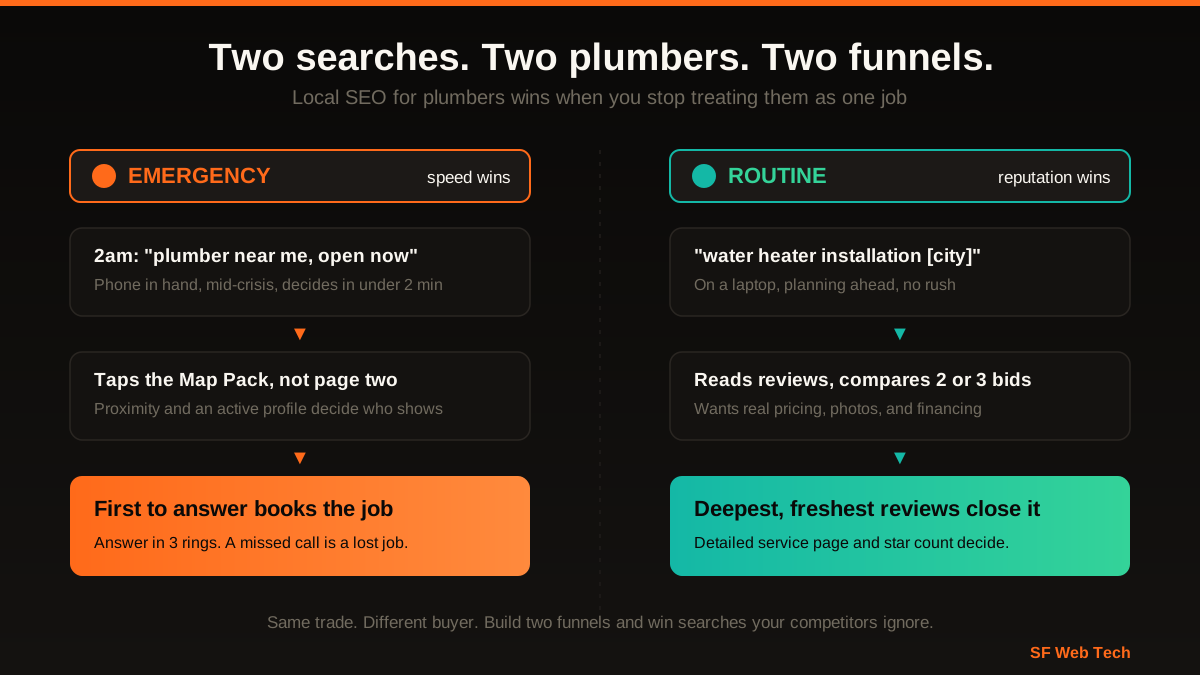
Here is the truth almost no plumbing SEO guide tells you: you are not running one marketing problem, you are running two. Emergency and routine plumbing are different buyers, searching different ways, at different times, deciding on different signals. Treat them as one and you will underperform on both. Split them and you can dominate a market other plumbers are fighting over blindly.
Emergency and routine plumbing are two different businesses
Think about the two people searching for a plumber this week. One has sewage backing up into a bathtub right now. The other is browsing on a laptop, planning to replace an aging water heater sometime next month and reading reviews before they call anyone. Same trade, completely different human.
Urgent and planned-service buyers can ask different questions. Use actual call reasons, device data and sales notes to decide whether separate pages or contact paths help. Do not assume every urgent caller ignores price or every planned buyer follows the same comparison process.
A broader service page can work when it clearly routes visitors to urgent and planned services. Create separate pages only when the scope, questions, availability or evidence differs enough to help the customer. Page count itself does not determine visibility or conversion.
- Possible searches: plumber near me, emergency plumber, burst pipe, open now
- Often mobile and time-sensitive, with urgency varying by problem
- Decision time can be short, but should be measured from real inquiries
- Useful elements: accurate availability, accessible calling, clear service coverage
- Profile focus: truthful hours, categories, services, and contact details
- Price and qualification still matter; urgency does not prove low sensitivity
- Possible searches: water heater installation, drain cleaning cost, repipe quote
- Desktop or mobile research with a wider planning window
- Decision time varies by project, household, and estimate process
- Useful elements: genuine reviews, detailed service pages, and pricing context
- Profile focus: permissioned photos, accurate services, useful updates
- Comparison behavior varies; do not assume a fixed number of bids
How local results fit an urgent-service path
A local results panel can appear above standard organic links for some location-based searches. Its order varies by searcher, place and time. Keep the profile useful, but maintain working organic, paid, referral and direct paths because no single placement is assured.
Google says local results are based mainly on relevance, distance and prominence. Accurate business information and useful service details help customers understand the business, but these factors are not entirely under the owner’s control and cannot guarantee a position.
Assess local visibility at selected locations and dates alongside real inquiries. A regional chart or profile score should not imply a known weighting for Google’s ranking factors.
Your Google Business Profile is the foundation
Check the profile for accurate categories, actual services, current hours and working contact details. These improvements help customers understand the business, without guaranteeing it outranks another listing.
Accurate profile data, useful service information, and qualified-inquiry measurement for plumbers.
See our Local SEO serviceA field-by-field walkthrough focused on accuracy, usefulness, and current profile rules.
Read: the full GBP optimization playbook for contractorsCoverage pages should help customers understand where service is available
Coverage pages can explain real operating areas, scheduling limits, service differences or documented work. They do not change the business location or guarantee visibility outside it. Use an overview when separate pages would only repeat place names.
Avoid near-identical location pages. Each retained page should answer a distinct customer question with verified coverage or project information. Consolidate pages that cannot provide meaningful differences.
- One page per city or neighborhood you actually service, not one per zip code you wish you did
- Unique content on each: local landmarks, a real job you did there, the specific problems common in that area's housing stock
- Both intents on the page: an emergency block with a click-to-call and a routine block with your service list and pricing guidance
- Real reviews from customers in or near that city
- Embedded map and honest coverage notes, no fake addresses
Accurate availability and reliable response help customers reach the right service. Track what happens after the inquiry; neither a ranking nor a fast answer proves that a job was won.
Use reviews and response records as separate evidence
Reviews may help a planned-service buyer evaluate fit. Invite eligible customers to leave honest feedback in their own words, and avoid incentives, screening or prescribed service phrases. Record review activity separately from calls, qualification and bookings.
For urgent inquiries, publish only the availability and response process the office can support. Reviews and map visibility do not guarantee a call, and a fast answer does not prove that the inquiry was qualified or became a job.
Invite honest feedback after eligible work through an appropriate channel. Do not select only happy customers or ask them to include particular service or city keywords. Let customers describe their own experience.
A neutral, policy-aware process for requesting and responding to customer feedback.
Read: how contractors get more Google reviewsSpeed to lead: the emergency multiplier
A visible contact path and reliable response help the caller reach the business. Track missed calls, accepted inquiries, qualification and bookings. Do not infer that a map position caused the phone to ring or that response speed alone caused a sale.
Emergency and routine inquiries may need different routing, qualification, and response expectations. Publish the staffed emergency process accurately and give routine customers a clear expected response window. Use real lead outcomes to set coverage rather than assuming every late-night call is urgent or every routine customer can wait.
When you need emergency calls faster than SEO can deliver them, paid search fills the gap.
Read: Google Ads for plumbersUse a practical call and form workflow before increasing lead volume.
Route plumbing inquiries by urgency and fitYour first 30 days: a plumber local SEO playbook
Prioritize accuracy first: profile details, service scope, coverage, contact routing and measurement. Add pages or review-process changes only when customer questions and evidence support them. No fixed order guarantees a faster local-ranking change.
- Claim and fully verify the Google Business Profile if you have not already
- Choose the primary category that best matches the core business and add only secondary categories for services genuinely offered
- Publish accurate hours and enable 24-hour or emergency attributes only when the business actually provides that availability
- Audit the business name, address or service-area setup, and phone number across important customer-facing profiles; correct material inconsistencies
- Publish a representative set of permissioned job photos and add new evidence when useful rather than following an arbitrary quota
- Build emergency and routine service pages when the intent, content, and call to action are meaningfully different
- Publish a service-area page only when it contains distinct local evidence and genuinely helps customers; do not clone a template across cities
- Request honest feedback consistently without incentives or screening customers by expected sentiment
- Make the phone action easy to find on emergency pages and the profile
- Track calls by source and separate interactions, accepted leads, appointments, estimates, won jobs, and paid revenue
Review profile accuracy, service pages, coverage, and lead measurement with SF Web Tech.
Book a free plumber local SEO auditSources and further reading
- Google Search: SEO Starter Guide
Crawlable links, descriptive page information and content organization. Practical trade examples are SF Web Tech recommendations.
Source checked .
- Google Business Profile: local ranking guidance
Google’s broad relevance, distance and prominence guidance. No exact ranking weights or guaranteed service-area coverage are stated.
Source checked .
- Google Maps: prohibited and restricted content
Rules against fake engagement, incentives and selectively soliciting positive reviews.
Source checked .
- Google Business Profile: business representation guidelines
Accurate real-world business details, categories, hours, storefront and service-area requirements, and the limits on category use.
Source checked .
- Google Business Profile: manage service areas
Service-area eligibility, address handling, specificity, the 20-area limit, and Google’s approximate two-hour boundary guidance.
Source checked .